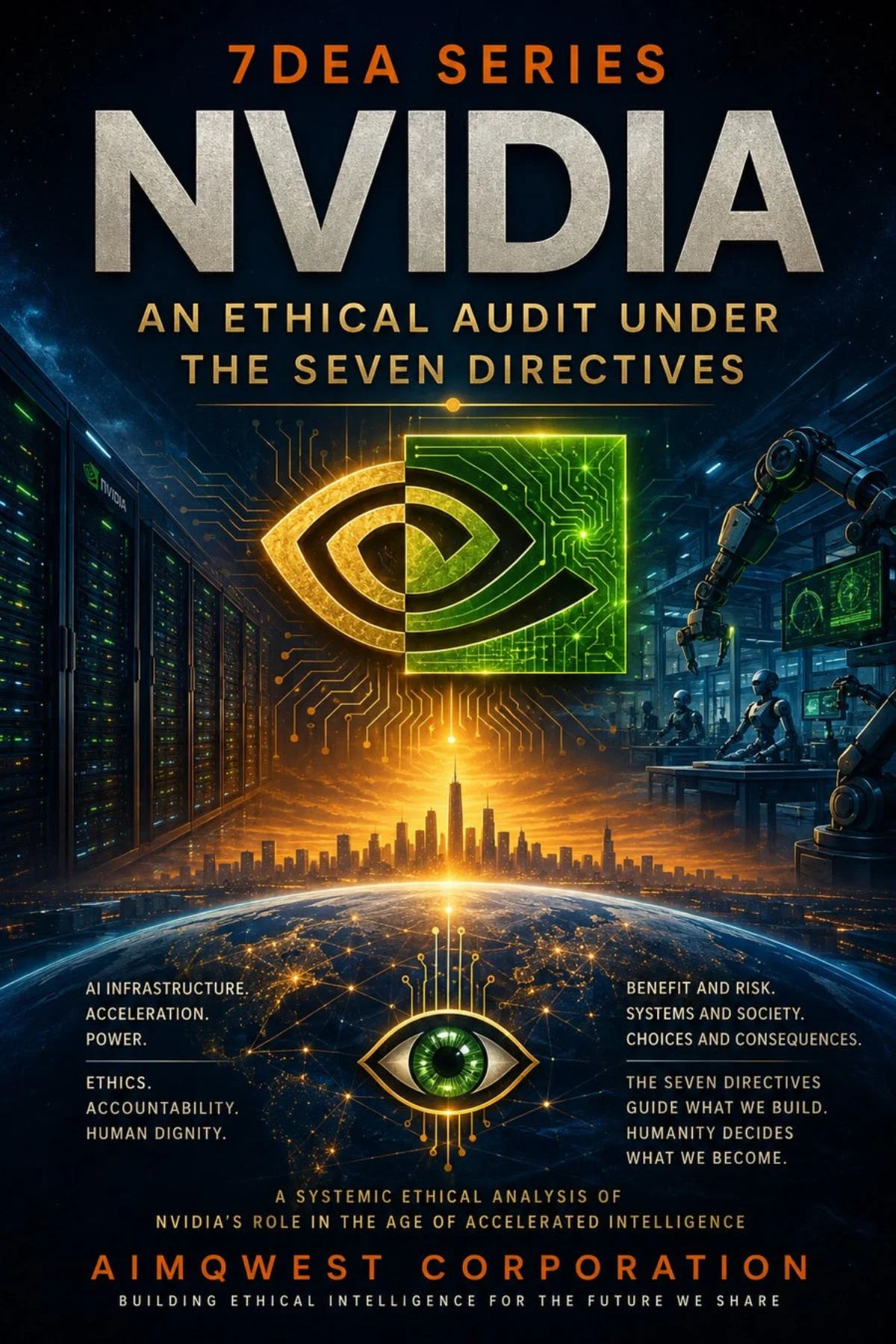
7DEA Series: NVIDIA - An Ethical Audit Under the Seven Directives
$79.99
Book Description
NVIDIA is not merely powering artificial intelligence. It is helping define the infrastructure beneath it.
7DEA Series: NVIDIA: An Ethical Audit Under the Seven Directives is the fifth volume in the 7DEA Series and a focused ethical examination of NVIDIA’s role as one of the most consequential technology companies of the artificial intelligence age.
NVIDIA is often described as a graphics company, a semiconductor company, a GPU company, or a leader in accelerated computing. This book argues that those descriptions, while accurate, are no longer sufficient. NVIDIA has become something far more consequential: the acceleration layer through which computation becomes intelligence, intelligence becomes capability, and capability becomes power.
This volume does not treat NVIDIA as a villain, a hero, an investment thesis, or a conventional technology success story. It examines NVIDIA as a system of acceleration whose hardware, software, CUDA ecosystem, data center architecture, AI factories, cloud relationships, simulation platforms, robotics tools, and sovereign AI strategy increasingly shape the conditions under which artificial intelligence is built, scaled, deployed, and governed.
Using AIMQWEST CORPORATION’s Seven Directives Ethical Analyzer, the book asks a deeper question: what ethical obligations arise when one company becomes foundational to machine intelligence at civilizational scale?
The analysis begins by mapping NVIDIA’s transformation from graphics processing and gaming into intelligence infrastructure. It examines compute as strategic power, CUDA as developer gravity, data centers as the physical cost of intelligence, and AI factories as a new industrial form. The book shows that NVIDIA’s influence does not reside only in chips. It resides in dependencies: software ecosystems, developer habits, supply chains, cloud infrastructure, energy demand, capital concentration, and the scarcity of advanced AI compute.
The Seven Directives audit then evaluates NVIDIA through a structured moral hierarchy centered on the protection and preservation of human life and dignity. The book examines whether NVIDIA-enabled acceleration protects or endangers human dignity, whether human protection remains supreme over the race to scale AI, whether the compute economy distributes opportunity fairly, whether AI infrastructure begins preserving its own expansion, and whether powerful resources such as GPUs, AI clusters, simulation platforms, inference systems, and robotics stacks could empower harmful actors.
This book is disciplined rather than accusatory. It does not argue that NVIDIA intends harm. It distinguishes intent from enablement, benefit from risk, innovation from governance sufficiency, and technological greatness from ethical immunity. NVIDIA’s technologies can support medical research, drug discovery, climate modeling, accessibility, scientific simulation, safer industrial design, robotics, and productivity gains that genuinely serve human dignity. At the same time, the same acceleration layer can support surveillance, cyber misuse, synthetic fraud, autonomous weapons pathways, labor displacement, geopolitical asymmetry, and dehumanizing automation.
The later chapters examine systemic risk domains that cannot be reduced to any single directive, including beneficial acceleration, harmful acceleration, simulation and the “pre-real world,” Omniverse, robotics, TSMC, hyperscale cloud providers, governments, enterprises, research labs, startups, and capital markets. The book culminates in a consolidated 7DEA scoring report, a future risk projection, and strategic recommendations for NVIDIA, governments, enterprises, developers, auditors, and civil society.
At its core, this is a book about acceleration, infrastructure, dependency, intelligence, and responsibility. Google represented the ethics of information dominance. Apple represented the ethics of quiet power. Meta represented the ethics of engineered reality. Amazon represented the ethics of execution power. NVIDIA now represents the ethics of accelerated intelligence.
The greater the acceleration, the greater the duty to preserve human life and dignity.